

2026.2.25
RESEARCH NEWS STORY
Eggs in the Human Diet and Cardiovascular Health: What the Science Actually Says
Analysis of trials and global data shows modest cholesterol changes, with moderate egg intake, are largely neutral for heart health
Are eggs bad for the heart? A review examines the long-standing concern that eggs raise cardiovascular risk. Analyzing clinical trials, cohort studies, and global data, researchers found that while eggs may modestly increase cholesterol, they also raise high-density lipoprotein (HDL), the “good” cholesterol, with little evidence that this translates into a higher risk of cardiovascular disease. The findings support the inclusion of moderate egg consumption as part of a healthy diet.
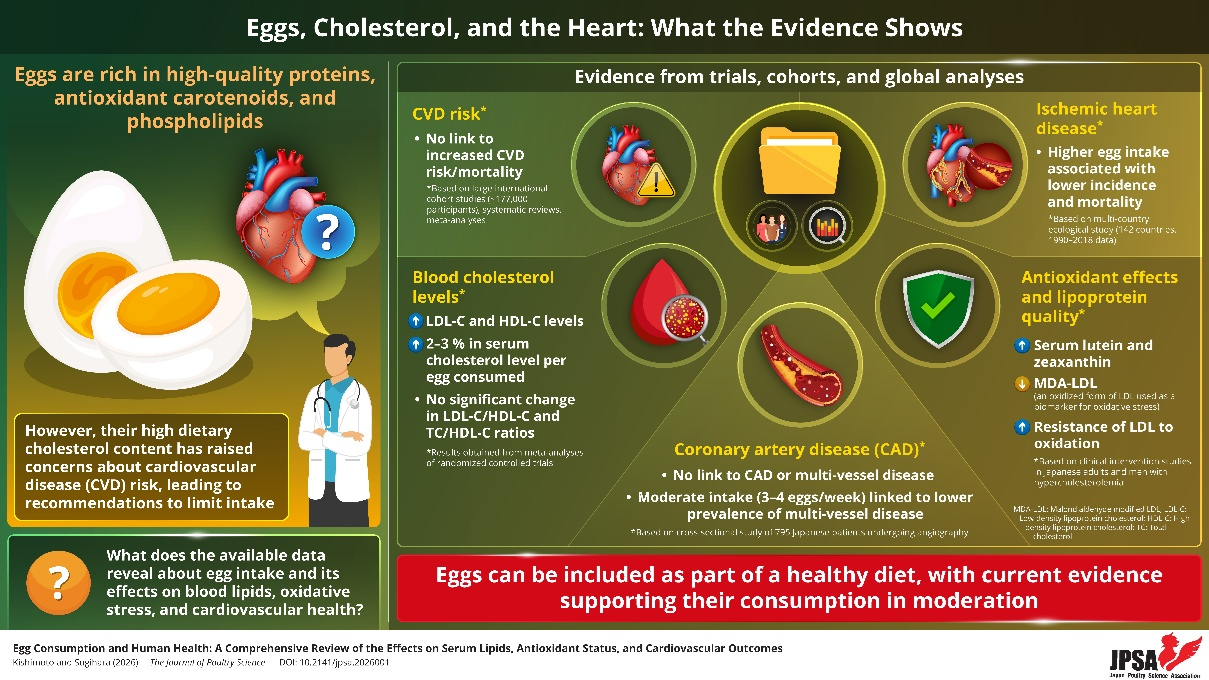
Image title: Clarifying the Effects of Egg Consumption on Heart Health
Image caption:A review of clinical trials, population studies, and global datasets finds little evidence that moderate egg consumption of one egg per day increases cardiovascular disease risk, and some populations may even experience protective effects.
Image credit: Associate Professor Yoshimi Kishimoto from Setsunan University, Japan
License type: Original content
Usage restrictions: Cannot be used without permission
Eggs are one of the most affordable and nutrient-dense foods available. They deliver high-quality protein along with antioxidant carotenoids such as lutein and zeaxanthin. Despite this rich nutritional profile, eggs have often been viewed with skepticism because they are a significant source of dietary cholesterol, impacting serum cholesterol levels. Because of this, limiting egg consumption has been a common recommendation to prevent high cholesterol and reduce the risk of heart disease.
To shed light on this scientifically inconclusive topic, researchers from Japan conducted a recent review study. The study was published online in Volume 63 of The Journal of Poultry Science on January 06, 2026, and revealed a more nuanced picture, suggesting that while eating eggs can lead to modest increases in total blood cholesterol, the overall impact on cardiovascular health appears largely neutral and, in some populations, may even be associated with a lower risk. The study was conducted by Associate Professor Yoshimi Kishimoto from the Department of Food Science and Human Nutrition at Setsunan University and Assistant Professor Norie Sugihara from the Faculty of Health and Social Services at Kanagawa University of Human Services, Japan.
To assess how egg consumption affects health, the researchers examined a wide range of evidence from clinical trials, observational studies, and global ecological data. “In Japan, a large cohort study published in 2006 showed that daily or nearly daily egg consumption did not increase the incidence of coronary heart disease. Conversely, a recent US study associated high egg consumption with increased cardiovascular disease (CVD) risk and all-cause mortality. Hence, the evidence remains inconclusive,” says Dr. Kishimoto, highlighting the need for a comprehensive look at the data.
To understand the effects on blood cholesterol levels, the researchers turned to randomized controlled trials. A meta-analysis of 28 studies reported that egg consumption slightly increased total cholesterol and low-density lipoprotein cholesterol (LDL-C), commonly referred to as ‘bad’ cholesterol, but it also raised high-density lipoprotein cholesterol (HDL-C), or the ‘good’ cholesterol. Importantly, the ratio between LDL-C and HDL-C, which is regarded as a more important marker of plaque risk in the arteries, did not change significantly. A larger review published in 2020, covering 66 trials, reached much the same conclusion.
In studies of Japanese adults, adding one egg per day to the diet for several weeks significantly increased blood levels of lutein and zeaxanthin and improved LDL’s resistance to oxidation. Researchers observed lower concentrations of malondialdehyde-modified LDL (MDA-LDL), a marker of oxidized LDL that is linked to plaque buildup in the arteries.
The review also found little evidence of a direct association between egg intake and CVD risk. International cohort studies involving roughly 177,000 people across 50 countries reported no significant link between egg consumption, blood lipid levels, mortality, or major cardiovascular events. Moreover, a meta-analysis conducted in 2020 suggested that consuming up to one egg per day was not associated with higher CVD risk and might even be associated with lower risk in Asian populations.
Research examining Japanese patients undergoing coronary angiography reached similar conclusions. The prevalence of coronary artery disease did not differ meaningfully among those eating fewer than three eggs per week, three to four per week, or at least one per day. Among patients not taking lipid-lowering medications, moderate egg consumption was associated with a lower prevalence of multi-vessel disease.
On a broader scale, an analysis of data from 142 countries between 1990 and 2018 found that nations with higher average egg intake tended to report lower incidence and mortality from ischemic heart disease. “In conclusion, current evidence supports the inclusion of eggs in a balanced diet, particularly when consumed in moderation. Their nutritional and functional properties warrant continued attention in clinical nutrition and public health,” says Dr. Kishimoto.
This study contributes to a growing body of research suggesting that eggs may fit comfortably within healthy dietary patterns, while highlighting future directions regarding population specificity and genetic factors to provide evidence-based dietary guidelines.
Reference
| Title of original paper: |
Egg Consumption and Human Health: A Comprehensive Review of the Effects on Serum Lipids, Antioxidant Status, and Cardiovascular Outcomes |
|---|---|
| Journal: | The Journal of Poultry Science |
| DOI |
Additional information for EurekAlert
| Latest Article Publication Date: | 06 January 2026 |
|---|---|
| Subject of Research: | Literature review |
| Subject of Research: | People |
| Conflicts of Interest Statement: | The authors declare no conflicts of interest. |
About Setsunan University in Japan
Setsunan University is a private university in Osaka Prefecture, Japan, with campuses in Neyagawa and Hirakata. With approximately 11,000 students and 422 academic staff, the university offers 17 diverse departments across nine faculties in the fields of law, international studies, economics, business administration, contemporary social studies, science and engineering, pharmaceutical science, nursing, and agriculture. Committed to practical learning and global engagement, the university maintains partnerships with over 36 universities worldwide.
Website: https://www.setsunan.ac.jp/
About Associate Professor Yoshimi Kishimoto from Setsunan University, Japan
Dr. Yoshimi Kishimoto is an Associate Professor at Setsunan University, Japan. Her research focuses on dietary antioxidants, including polyphenols and carotenoids, and their impact on health. She studies their role in reducing key risk factors for atherosclerosis, such as oxidative stress and inflammation, and their ability to improve vascular function. Dr. Kishimoto also estimates polyphenol intake in Japanese populations and examines its relationship with lower risks of mortality from cardiovascular disease. Her multidisciplinary approach spans from basic laboratory research to clinical and epidemiological studies, aiming to clarify how these nutrients support disease prevention and health promotion.
Funding information
Not applicable
Media Contact
Kazuhisa Honda
E-mail: honda@tiger.kobe-u.ac.jp
Web: https://jpn-psa.jp/en/home-en/